California
ADU permit rules are set statewide: an application is decided ministerially, without discretionary review or a hearing.
ADU planning · California & Florida
Answer five questions and we will come back with what your state's law actually allows, a planning range, and the realistic next step. No obligation, and no guesswork dressed up as a quote.
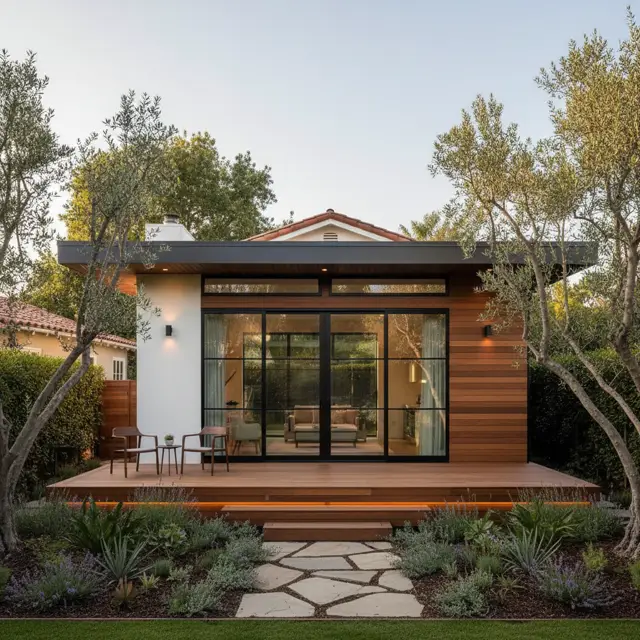 AI-generated example
Three finish levels, same footprint idea. These are AI-generated examples made to show the range — not photographs of a built project, and not a design proposal for your lot.
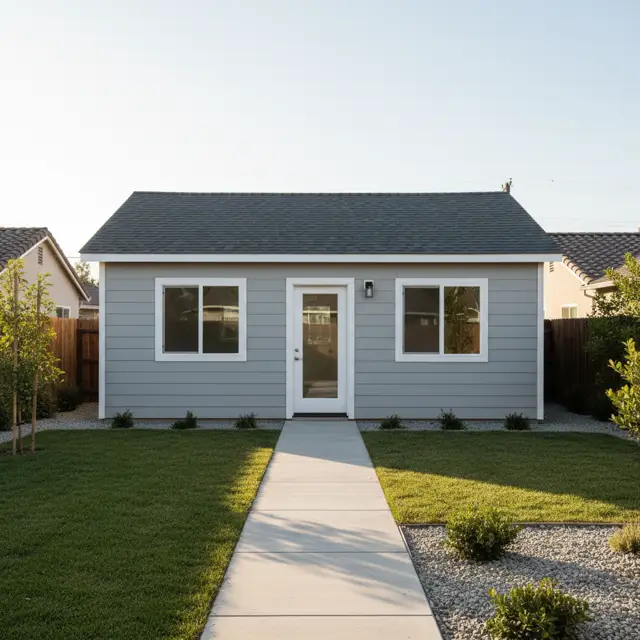 AI-generated example
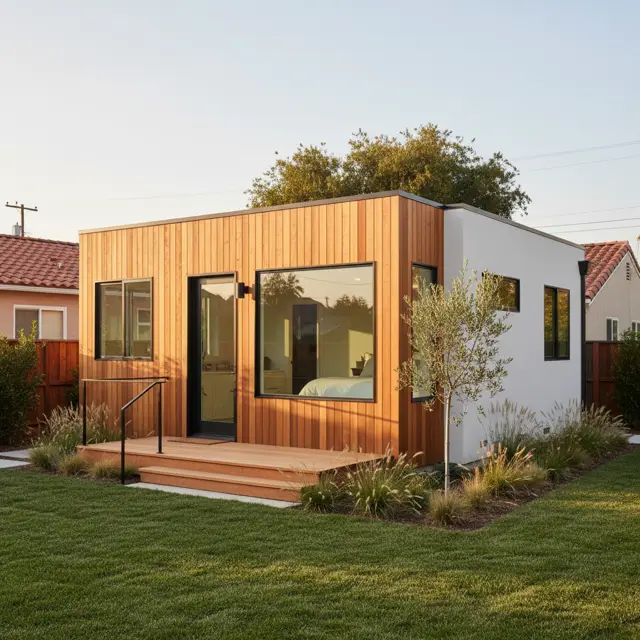 AI-generated exampleAI-generated example
ADU permit rules are set statewide: an application is decided ministerially, without discretionary review or a hearing.
State law lets each city or county choose whether to allow ADUs in single-family zones — it does not require them to.
California sets ADU permit rules statewide: an ADU permit application is decided ministerially, without discretionary review or a hearing.
State ADU law lives in Government Code §§ 66310–66342. It was moved there by SB 477, in effect from 25 March 2024; much of what is online still cites the repealed § 65852.2.
An ADU permit application is considered and approved ministerially, without discretionary review or a hearing.
Where there is an existing single-family or multifamily dwelling on the lot, the permitting agency must approve or deny a completed ADU application within 60 days, and if it has not, the application is deemed approved. If the ADU is filed together with a permit for a new home on the lot, the agency may wait until it decides that permit, and a delay you request pauses the 60 days.
The state publishes an ADU Handbook through the Department of Housing and Community Development, which is the authoritative plain-language guide.
Fees, setbacks, utility connection rules and review times are set locally and vary between cities in the same county. We do not quote them here.
Florida has no single statewide ADU permission — it is decided city by city, county by county.
Section 163.31771(3): “A local government may adopt an ordinance to allow accessory dwelling units in any area zoned for single-family residential use.” It allows cities and counties to permit ADUs; it does not require them to.
Section 163.31771(4): “An application for a building permit to construct an accessory dwelling unit must include an affidavit from the applicant which attests that the unit will be rented at an affordable rate to an extremely-low-income, very-low-income, low-income, or moderate-income person or persons.” Ask your city or county how it applies this before you plan how the unit will be used.
Because subsection (3) is permissive rather than mandatory, whether you may build an ADU depends on your own city's or county's land development code.
Florida has not changed this law in 2026. SB 48 (2026), a bill that would have amended section 163.31771, passed the Senate 38–0 on 4 February 2026 and died in the House on 13 March 2026. The section was last amended in 2020 (ch. 2020-27).
Which Florida jurisdictions currently permit ADUs, and on what terms, is exactly the question we research per address. We do not publish a list we cannot keep current.
Any figures shown are an AI-assisted range for planning purposes — not a binding quote. ADU rules, fees and feasibility are set locally and change. Nothing here is legal advice. A licensed local professional gives you the firm proposal.
We are not a contractor and not a law firm. We help you work out what is possible and connect you with licensed local professionals.